
The short version
If you’ve ever wondered why your bill feels high even when you’re careful, the culprit is often wasted (a.k.a. “dirty”) electricity created by motors and compressors—think HVAC, refrigerators, pumps, and more. A Smart Electricity Optimizer reduces that waste, protects your equipment, and typically cuts electricity costs—often up to ~22% for homes and up to ~35% for commercial sites, based on real-world results and manufacturer data. It works with or without solar.
Understanding the components that contribute to your electricity bill can empower you to make more informed decisions about energy use. It’s essential to know what ‘dirty’ electricity entails; it refers to electrical energy that is not used efficiently and can result in higher operational costs.
What is a Smart Electricity Optimizer?
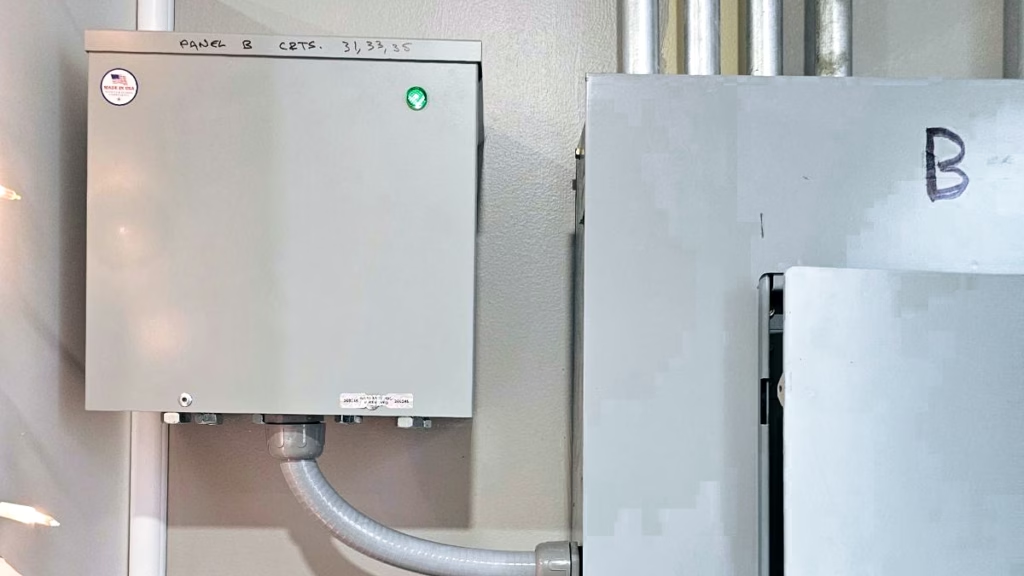
What Is a Smart Electricity Optimizer?
These devices offer significant benefits not only in terms of cost savings but also in enhancing the overall lifespan and efficiency of your household appliances. For example, HVAC systems that operate under optimal conditions are less likely to encounter mechanical failures, which can be costly to repair.
A smart electricity optimizer is a UL/CuL-listed power factor correction device that reduces dirty electricity (harmonic distortion) and recycles otherwise wasted energy back to your motor loads (HVAC, pumps, refrigeration). The result: fewer kWh, cooler/longer-lasting equipment, and lower electric bills—whether or not you have solar.
At a glance
- Home savings: commonly 10–25% (often ~22%)
- Commercial savings: often 20–35%
- Protection: whole-home/whole-site surge protection (up to 2,400 joules, model-dependent)
- Compatibility: single-phase (up to 240V) & three-phase (up to 480V); works with solar
- Certifications: UL & CuL listed; NEMA 3R enclosure
- Install time: ~20 minutes by a qualified electrician
How It Works (Plain English)
Motors and compressors don’t draw power perfectly. Some energy becomes reactive and harmonic noise (a.k.a. dirty electricity) that doesn’t perform useful work—but you still get billed.
A smart electricity optimizer:
- Conditions incoming power to reduce harmonic distortion.
- Improves power factor, so motors use more “real” power and waste less.
- Buffers & returns stored energy back to motors when needed, reducing heat and wear.
Outcome: lower consumption for the same output, better HVAC efficiency, smoother operation, and bill reductions you can see on the next cycle.
Imagine a scenario where your HVAC system runs more efficiently due to the reduced wear and tear facilitated by the smart electricity optimizer. This not only lowers your energy bill but also prolongs the lifespan of the system, reducing the need for early replacement.
Who Gets the Biggest Wins?
Residential (Renters & Homeowners)
- Central air/heat pumps, well & pool pumps, refrigerators/freezers, washers/dryers, ceiling fans
- Typical savings: up to ~22% on electricity usage
- With solar: frees up more generation to sell back or offset night/cloudy load
Commercial & Agricultural
- Grocery & convenience stores, restaurants, cold-storage, farms/irrigation, car washes, hotels/gyms, warehouses, office & theme parks
- Typical savings: 20–35%—especially with long motor-driven equipment runtimes
- Added surge protection helps protect expensive compressors and controls
Real-World Snapshot (Residential)
“We had the Optimizer installed and our consumption from the utility went down by 22%. We’re excited to see year-over-year savings.” — Paula J., Broomfield, CO
In addition to the appliances mentioned, energy optimization can significantly benefit electric vehicle charging. With the rising popularity of EVs, ensuring that charging is efficient not just saves costs but can also help in managing the overall load on your home’s electrical system.
Solar vs. Optimizer (They’re Better Together)
- Solar changes your energy source.
- An electricity optimizer changes how efficiently you use that energy.
Together, they maximize ROI: buy less, need less, and protect your gear.
Moreover, for commercial establishments, the implications of energy savings are even more pronounced. For instance, a restaurant that implements a smart electricity optimizer can see a marked decrease in energy costs, allowing for reinvestment into other areas of the business such as staff training or equipment upgrades.
Safety, Specs & Installation
- UL & CuL listed, NEMA 3R indoor/outdoor enclosure
- Surge protection up to 2,400 joules (model dependent)
- Single-phase: up to 240V/200A | Three-phase: up to 480V
- Operating life: commonly 20–25 years; models rated to 60,000 hours
- Install: typically ~20 minutes at panel (more for multi-unit/commercial deployments)
FAQs
Do I need solar for this to work?
No. It delivers value with or without solar.
How much can I expect to save?
Homes commonly 10–25% (often ~22%); commercial sites 20–35%, depending on load profile and runtime.
Will it affect equipment warranties?
It conditions power and reduces heat/stress—generally positive for longevity. Always use a qualified installer.
When will I see results?
Typically on the next billing cycle, with clearer trends in 60–90 days.
Is there maintenance?
No routine maintenance required.
The integration of technology with smart electricity optimizers continues to evolve. In the future, we might even see advancements that further enhance energy efficiency using artificial intelligence (AI) and machine learning algorithms to analyze energy usage patterns and suggest actionable insights for users.
Bottom Line
A smart electricity optimizer is a fast, affordable way to reduce dirty electricity, improve power factor, protect equipment, and lower your electric bill—no equipment replacement required. With proper implementation, you can look forward to significant energy savings while enhancing the longevity and efficiency of your electrical systems.
Ready to see your savings?
Commercial & Agriculture: Book a site evaluation »
Planning for the future, it is vital to consider how incorporating smart electricity optimizer technology can help mitigate the impacts of fluctuating energy prices and increased demand on the grid. By employing these technologies, you not only secure immediate savings but also future-proof your energy consumption strategies.
In conclusion, making the switch to a smart electricity optimizer is not just an investment in immediate savings; it’s a strategic move toward enhancing energy efficiency, prolonging the life of your equipment, and contributing positively to the environment.